This article contains advertising. Our booking links are routed through a partner that adds commission tracking automatically, so if you book through one we earn a commission from the provider, at no extra cost to you. It never affects what we recommend. Affiliate disclosure
Walk west along St Vincent Street from George Square and the pavement starts to climb. Keep going, and every cross-street you pass drops away steeply to your left towards the river and rises just as steeply to your right. That’s the grid, laid out by Victorian and Georgian developers who drew straight lines over a hill and let the builders worry about the gradients, and it’s the first thing to understand about Glasgow city centre. The second is that the centre is compact. From Central Station to the Royal Concert Hall, or from the Merchant City to Charing Cross, almost everything you’ll want is within 20 minutes on foot, packed with Victorian commercial palaces, department stores, theatres, bars and some of the best music venues in Britain.
This guide explains how the city centre fits together: the grid and the Style Mile, the main streets and what each one is for, the stations, the river edge, the theatres and venues, what to see, where it’s worth going after dark and what has changed recently. It’s a map in words rather than a shopping guide or a list of hotels; for those, see our guides to shopping in Glasgow and the best city-centre hotels. Details were checked in October 2026; treat prices as the right order of magnitude.
Glasgow city centre at a glance
| City centre | The essentials |
|---|---|
| Where | North of the Clyde, inside the loop of the M8, from Charing Cross in the west to the High Street in the east |
| Main streets | Buchanan Street, Sauchiehall Street, Argyle Street, plus the grid of St Vincent, West George, Bath and Hope Streets |
| Main stations | Glasgow Central and Queen Street; Buchanan Bus Station for coaches |
| Subway | Buchanan Street, St Enoch and Cowcaddens |
| Key sights | George Square and the City Chambers, GoMA, Central Station, the Argyll Arcade, the Mackintosh Tearooms |
| Best for | First visits, shopping, theatres, live music and nightlife |
| Low Emission Zone | Yes: the centre is inside it, so non-compliant cars may not enter |
What things cost in the city centre
| Item | Price | Notes |
|---|---|---|
| Gallery of Modern Art (GoMA) | Free | Royal Exchange Square |
| George Square, the Argyll Arcade, Buchanan Street | Free | Free to wander, though the arcade’s jewellers aren’t cheap |
| Subway single / all-day cap | £1.80 / £3.40 | Contactless or Smartcard; a paper single is £1.85 |
| Park and ride, all day | About £8.15 | Includes a return Subway trip; all the sites are outside the Low Emission Zone |
| Low Emission Zone penalty | £60 | Halved if paid within 14 days, then doubling for repeat breaches |
| King’s Theatre pantomime | From £15 | 2026–27 season; see our pantomime guide |
| OVO Hydro cloakroom | £8.50 per item | If you’re heading west to a gig after a day in town |
The city centre is where the hotels, the big shops and the theatres are, so it’s not the cheapest part of Glasgow to eat and drink in, but GoMA, the streets and the architecture are free, and lunch deals and pre-theatre menus are everywhere. Our guide to lunch deals and pre-theatre dining is the best way to eat well for less.
The grid: how the city centre is laid out
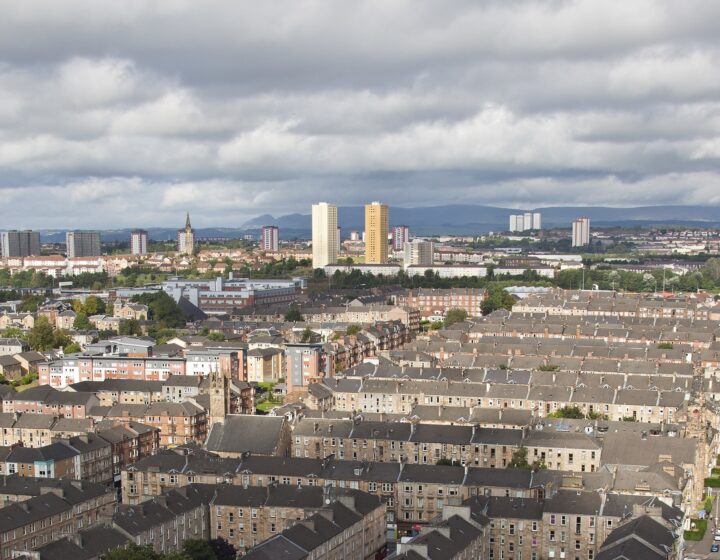
The heart of the centre is the grid on Blythswood Hill, laid out from the late eighteenth and early nineteenth centuries as a planned new town for the merchant class. The streets run east–west (Sauchiehall, Bath, West Regent, West George, St Vincent and Bothwell Streets, roughly from north to south) and north–south (Buchanan, West Nile, Renfield, Hope, Wellington, West Campbell and more), crossing at right angles regardless of the slope. The result is a city centre that’s easy to navigate – you can’t get very lost in a grid – but surprisingly hard on the legs.
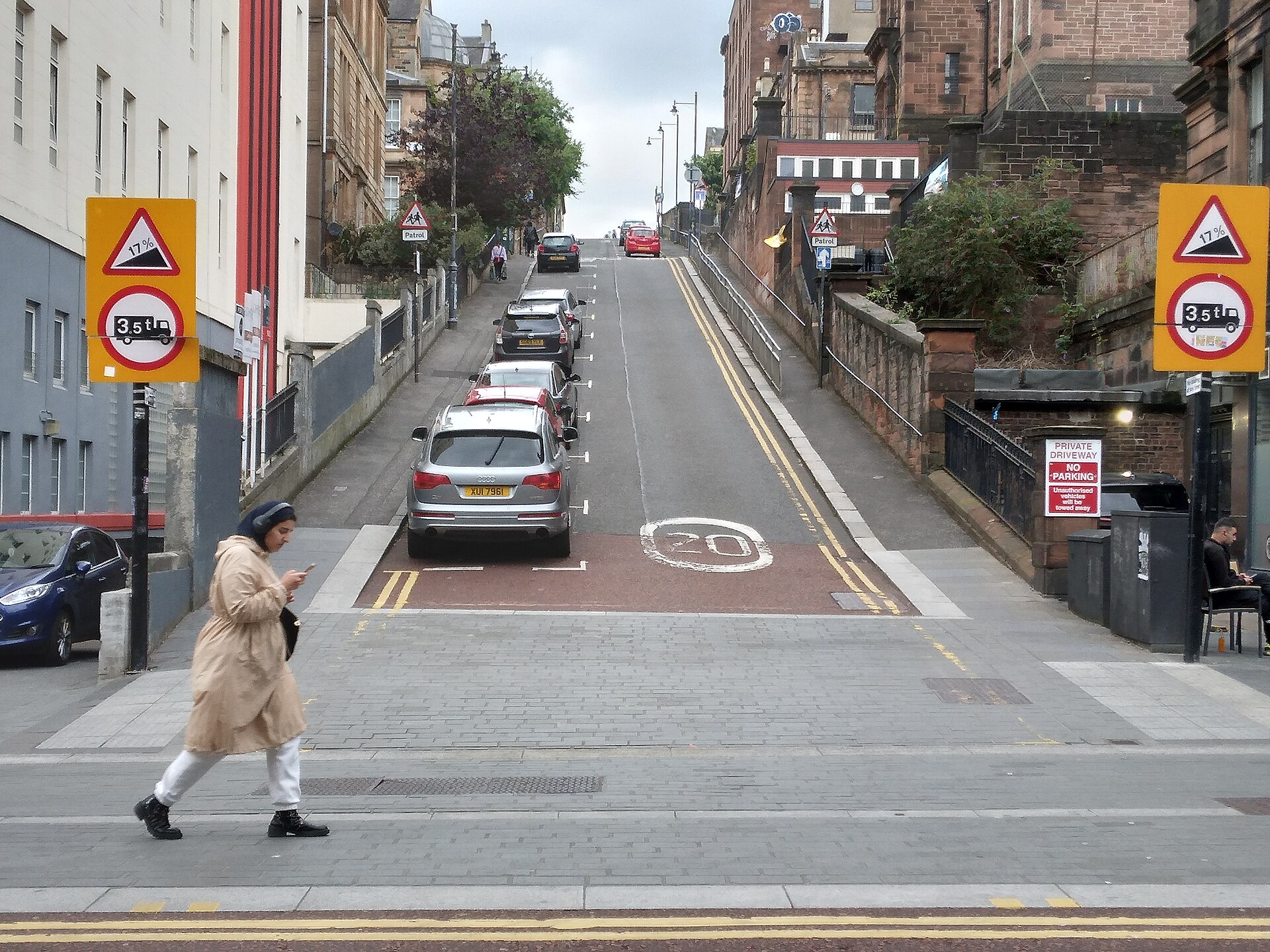
The buildings along these streets are the reason to look up. Glasgow’s nineteenth-century banks, insurance companies, shipping lines and warehouses competed to outdo each other in stone, and the result is street after street of Italian palazzos, Greek temples, French chateaux and the odd Art Nouveau surprise, many with carved figures and lettering high above the shopfronts. Our guide to Victorian Glasgow architecture has a self-guided walk.
The Style Mile: Buchanan, Argyle and Sauchiehall Streets
The shopping centre of the city is a Z-shape of three streets that locals call the Golden Z, and the city’s marketing calls the Style Mile.
Buchanan Street
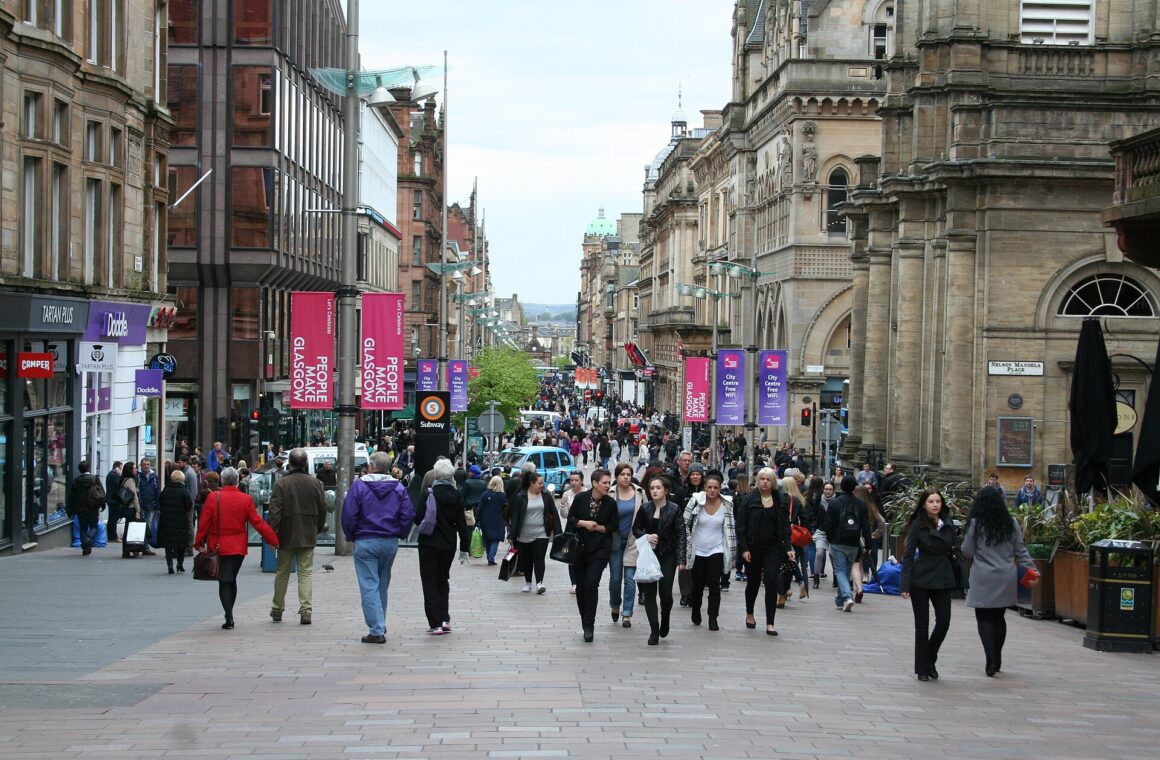
Pedestrianised, polished and always busy, Buchanan Street runs from St Enoch Square at the bottom up to the Royal Concert Hall at the top, with the statue of Donald Dewar on the steps. It has the flagship stores, the department stores and Princes Square, an Art Nouveau-style shopping arcade in a converted Victorian courtyard, and it’s where Glasgow’s best buskers play. It’s the street to walk first.
Argyle Street
Argyle Street runs east–west along the bottom of the grid, under the glass-walled railway bridge of Central Station and on towards Glasgow Cross. It’s busier, cheaper and scruffier than Buchanan Street, with high-street chains, the St Enoch Centre and, between Argyle Street and Buchanan Street, the L-shaped Argyll Arcade, built in 1827 and one of the oldest covered shopping arcades in Europe, now almost entirely jewellers.
Sauchiehall Street
Sauchiehall Street, the long street across the top of the grid, has had the hardest decade. The 2018 fire at the Glasgow School of Art’s Mackintosh Building, on the hill just above it, also gutted the O2 ABC music venue next door, and the street has struggled with empty units since. It still has real attractions: the Mackintosh Tearooms at number 217, the Royal Concert Hall at its eastern end, theatres, cinemas and late-night bars and venues. Its western stretch has been relaid as one of the city’s new “avenues”, with trees, wider pavements and a cycle lane.
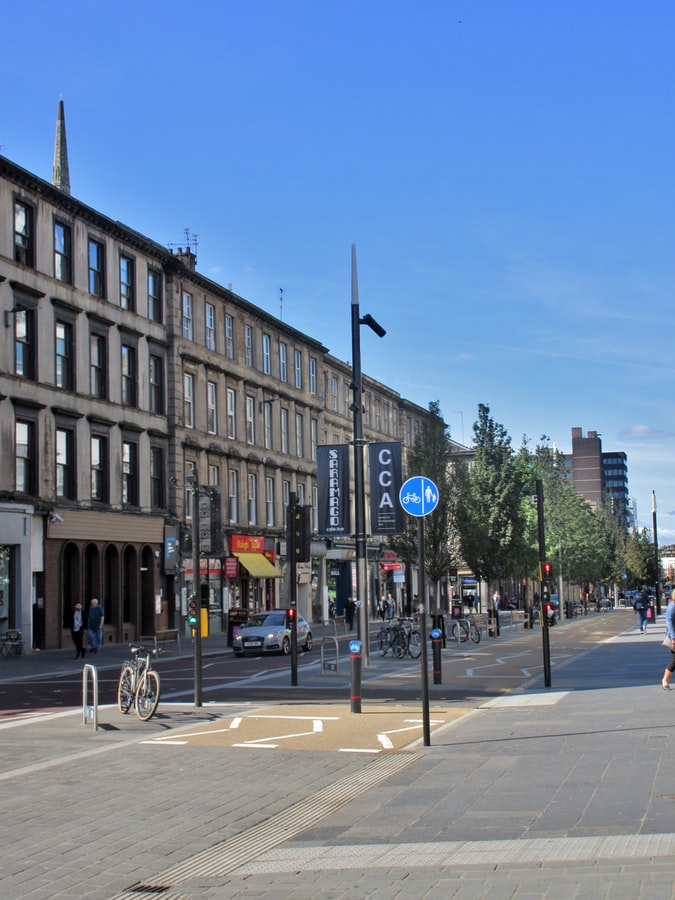
Our shopping guide covers the stores, and our guides to vintage shopping and Scottish gifts and tartan will help you find something better than the airport shops sell.
George Square and Royal Exchange Square
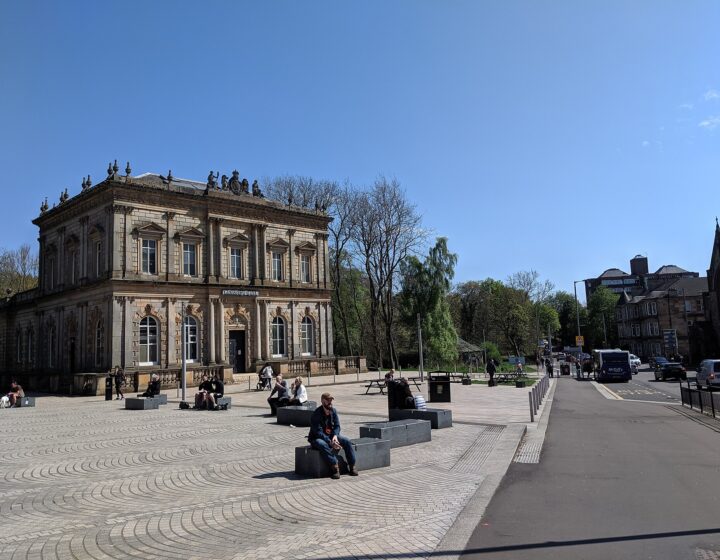
George Square is the city’s civic centre, with the City Chambers along its east side, Queen Street station on its north side and statues of everyone from Robert Burns to James Watt. It has just been through a major redevelopment, with new stone surfacing and trees: the square itself was due to reopen to the public at the end of August 2026, with a formal reopening in September, while work on some of the surrounding streets runs into spring 2027. Expect some hoardings nearby for a while yet.
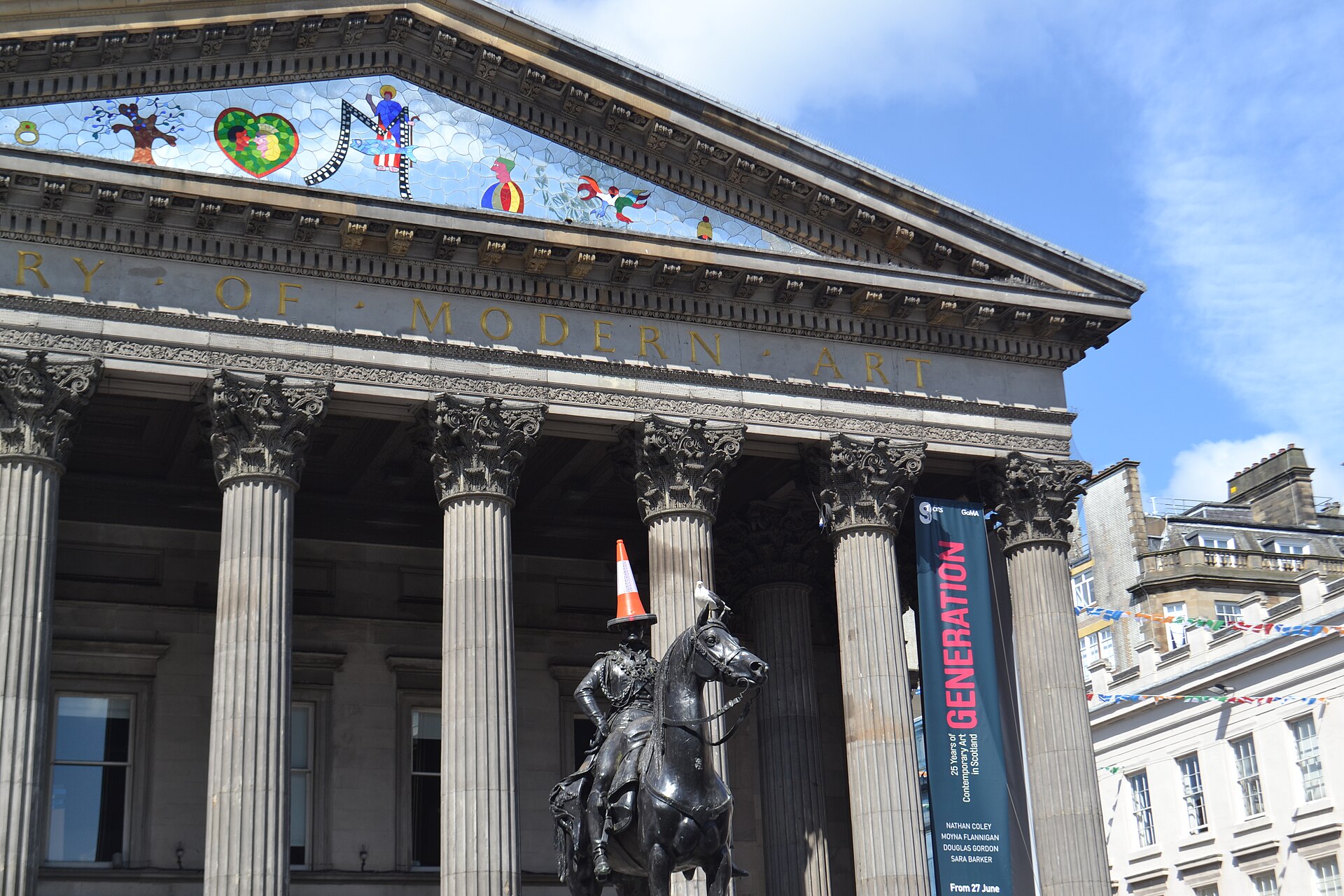
A couple of minutes south-west, Royal Exchange Square is built around a tobacco lord’s eighteenth-century mansion that became the Royal Exchange and is now the Gallery of Modern Art. GoMA is free, and the equestrian statue of the Duke of Wellington outside almost always has a traffic cone on his head, one of the city’s most cherished running jokes.
Central Station and the Hielanman’s Umbrella
Glasgow Central is one of the great Victorian stations, with a vast glazed roof over a concourse that’s a sight in itself. Where its platforms cross Argyle Street, the railway bridge with its long glass wall is known as the Hielanman’s Umbrella, because Highlanders who came to the city to work used to meet beneath it out of the rain on their days off. The station has also run guided tours of its hidden corners, which are worth looking out for if you like Victorian engineering.
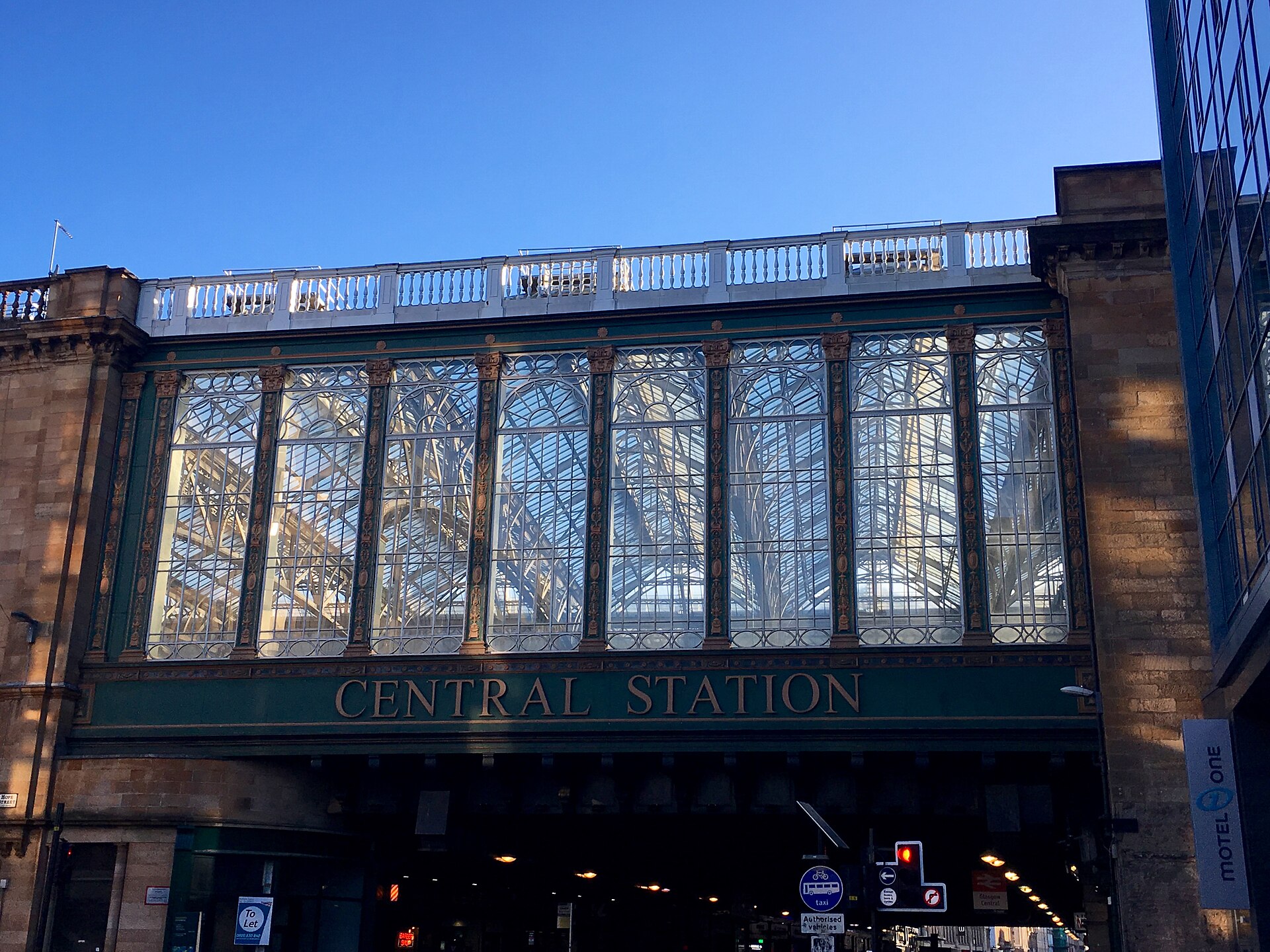
The area around the station is the centre’s busiest crossroads. Hope Street, Gordon Street and Union Street are lined with bars and cafés, and the river is a short walk south. For practical details about staying nearby, see our guide to hotels near Glasgow Central.
The theatre district and the north of the centre
Glasgow’s main theatres cluster on the northern side of the grid. The Theatre Royal on Hope Street, the oldest theatre in the city and home of Scottish Opera, sits near Cowcaddens; the King’s Theatre, a Frank Matcham design of 1904, is on Bath Street; and the Pavilion is on Renfield Street. The Glasgow Royal Concert Hall, home of the Royal Scottish National Orchestra, stands at the top of Buchanan Street, and the Royal Conservatoire of Scotland, a few minutes away on Renfrew Street, puts on hundreds of student performances a year. See our Glasgow theatre guide and, from November, our pantomime guide.
Further up the hill, Garnethill is a small, steep residential quarter above Sauchiehall Street, home to the Glasgow School of Art. Charles Rennie Mackintosh’s Mackintosh Building is still under restoration after the fires of 2014 and 2018, so you can only see it from the street, wrapped in scaffolding, opposite the school’s modern Reid Building. The Lighthouse, Mackintosh’s first public building in Mitchell Lane, has been closed since 2020 and isn’t currently open to visitors, so for Mackintosh interiors head to the Mackintosh Tearooms on Sauchiehall Street or, in the West End, the Mackintosh House. Our Charles Rennie Mackintosh guide lists the rest.
The river edge: the Broomielaw and the Clyde
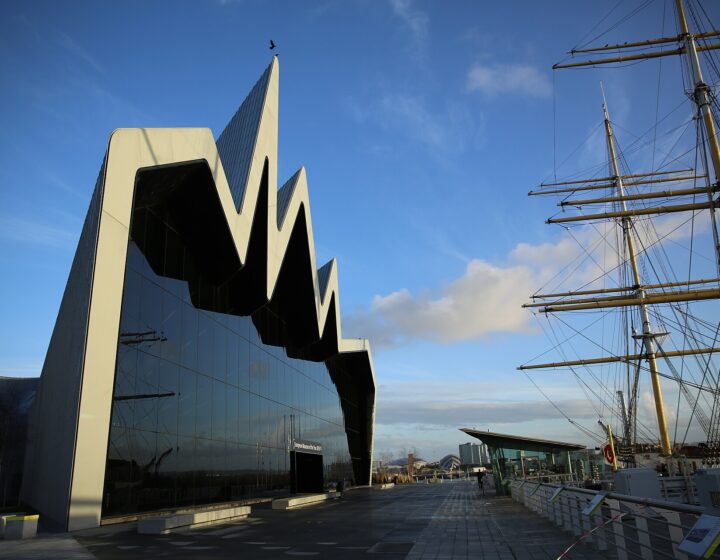
At the bottom of the grid, the Broomielaw runs along the north bank of the Clyde. This was the old quay where the Clyde steamers left for the coast, and it’s now an area of offices, hotels and riverside paths, with the Tradeston footbridge, the Squiggly Bridge, crossing to the south bank. It’s not a destination in itself, but it’s the start of the Clyde Walkway west to Finnieston, the SEC and the Riverside Museum, or east to Glasgow Green.
The city centre after dark
The centre is where most of Glasgow’s nightlife happens. King Tut’s Wah Wah Hut on St Vincent Street, where Oasis were signed in 1993, is the city’s most famous small venue; the Sub Club on Jamaica Street, open since 1987, is one of the world’s longest-running underground dance clubs; and Sauchiehall Street, Hope Street and Bath Street have bars, clubs and late-night venues for every taste. Our guides to King Tut’s, Glasgow nightlife and the best cocktail bars will point you in the right direction.
The honest note is that the centre’s after-dark character changes from street to street. Some streets are busy until the small hours at weekends; others, especially in the office district around Bothwell Street, are empty by 8pm. For a more relaxed evening, the Merchant City, on the eastern side of the centre, is the better bet.
A first day in the city centre
- 10am: Start in George Square, then walk to Royal Exchange Square for GoMA and the Duke of Wellington.
- 11.30am: Walk down Buchanan Street, with a detour into Princes Square, and through the Argyll Arcade to Argyle Street.
- 1pm: Lunch near Central Station, then look up at the Hielanman’s Umbrella from Argyle Street.
- 2.30pm: Climb through the grid along St Vincent Street, looking up at the buildings, to Sauchiehall Street for tea at the Mackintosh Tearooms.
- Evening: A show at one of the theatres, a gig at King Tut’s or a drink in the Merchant City.
For more ideas, see our guides to things to do in Glasgow and two days in Glasgow.
Getting around the city centre
On foot is best. The centre is small enough to walk across in 20 minutes, and the grid makes it easy to find your way. The Subway has three central stations – Buchanan Street, St Enoch and Cowcaddens – and is the quickest way out to the West End or the south side; with contactless you won’t pay more than £3.40 a day. Central and Queen Street stations are about ten minutes’ walk apart, and if you’re changing trains between them, allow for it. Our guide to getting around Glasgow covers buses, trains and taxis.
Don’t drive in unless you’re sure of your car. The city centre is inside the Low Emission Zone, which is a ban rather than a charge: a non-compliant car or van entering it is fined £60, halved if you pay within 14 days, and the penalty doubles for each further breach. Park and ride sites outside the zone cost about £8.15 a day, including a return Subway trip.
Is the city centre worth your time?
Yes, and on a short first visit it’s where you’ll spend much of it. The architecture is superb, the shopping is the best in Scotland, the theatres and music venues are excellent, and everything is close together. It’s also the obvious base for a short trip, with the stations and the airport bus on the doorstep.
The honest caveats: the centre is busy and noisy, parts of Sauchiehall Street look tired, some streets go quiet at night, and it isn’t where Glaswegians actually live. Spend a day here, then get out into the neighbourhoods. Our guide to Glasgow neighbourhoods shows how the centre fits with the rest of the city, and the West End guide is the obvious next step.
Glasgow city centre: frequently asked questions
What is the Style Mile in Glasgow?
The city’s name for its main shopping district, centred on the Z-shape of Buchanan Street, Argyle Street and Sauchiehall Street, along with the Merchant City and Princes Square. Locals call the three streets the Golden Z.
Is Glasgow city centre walkable?
Yes. Most of the centre is within 20 minutes’ walk of George Square, and the grid makes it easy to navigate, though some streets are steep.
Is George Square open?
The square was due to reopen to the public at the end of August 2026 after a major redevelopment, with a formal reopening in September. Work on some surrounding streets continues into spring 2027.
Is Sauchiehall Street worth visiting?
For the Mackintosh Tearooms, the Royal Concert Hall and its bars and venues, yes. It has struggled since the 2018 Art School fire, so expect empty units along some stretches.
Can I drive into Glasgow city centre?
Only in a vehicle that meets the Low Emission Zone standards. Non-compliant cars and vans are banned, with a £60 penalty that doubles for repeat breaches. Park and ride is the easier option.
Where does the city centre end and the Merchant City begin?
Roughly at Queen Street and Buchanan Street’s eastern side: the Merchant City is the older, eastern part of the centre, stretching towards the High Street.
Related Glasgow Guides
- Glasgow neighbourhoods: an area-by-area guide
- Buchanan Street
- George Square
- Shopping in Glasgow
- The Merchant City
- Glasgow theatre guide
- Victorian Glasgow architecture
- Glasgow nightlife
Photo Credits
Buchanan Street: Buchanan Street Glasgow 02 by MSeses, CC BY-SA 4.0, via Wikimedia Commons.
Garnet Street at Sauchiehall Street: Corner of Sauchiehall St and Garner St, Glasgow, Scotland by Ridiculopathy, CC0, via Wikimedia Commons.
The western end of Sauchiehall Street: Sauchiehall Street looking West by Adam Marikar, CC BY-SA 4.0, via Wikimedia Commons.
The Hielanman’s Umbrella: Hielanman’s Umbrella, Glasgow Central Station, 1 by LornaMCampbell, CC BY-SA 4.0, via Wikimedia Commons.