This article contains advertising. Our booking links are routed through a partner that adds commission tracking automatically, so if you book through one we earn a commission from the provider, at no extra cost to you. It never affects what we recommend. Affiliate disclosure
An hour south of Glasgow, the Ayrshire coast unfurls along the Firth of Clyde in a sweep of rocky headlands, sandy beaches, whitewashed fishing villages and clifftop castles. Add the birthplace of Scotland’s national poet, one of the National Trust for Scotland’s finest properties, views out to the volcanic island of Ailsa Craig and the snow-capped peaks of Arran, and you have one of the most rewarding day trips you can make from Glasgow. This guide covers everything you need to plan the perfect Ayrshire day trip from Glasgow — whether you are travelling by train, car or guided tour.
Getting from Glasgow to Ayrshire
By Train
ScotRail runs frequent services from Glasgow Central to Ayr, with the journey taking around one hour. Trains depart roughly every 30 minutes throughout the day, making it easy to choose your departure time. From Ayr station you are within walking distance of the town centre, Ayr beach and the Burns Monument, with local buses connecting to Alloway (home of the Robert Burns Birthplace Museum) in under 15 minutes. Kilmarnock is also served directly from Glasgow Central and makes a useful base if your focus is the northern part of Ayrshire.
If you plan to go further south to reach Culzean Castle, you can take the train to Maybole (on the Girvan line) and then a taxi or occasional bus for the final few miles. Alternatively, Stagecoach operates a seasonal bus service from Ayr to Culzean during summer. A day out combining public transport with local buses and taxis is entirely achievable, though a car gives you considerably more flexibility to explore at your own pace.
By Car
From Glasgow city centre, take the M77 motorway southbound — this is the fastest and most straightforward route. The motorway carries you past Kilmarnock and delivers you to the Ayr bypass in around 45 minutes under normal conditions. From Ayr, the A719 coastal road southward through Dunure and Croy to Culzean is one of the most scenic drives in the west of Scotland, hugging the shoreline with constant views across the Firth of Clyde. Allow around an hour for the full Glasgow-to-Culzean journey if traffic is light, and considerably more on busy summer weekends when the M77 can become congested.
Parking in Ayr town centre is plentiful and reasonably priced. Culzean Country Park has its own pay-and-display car park at the main entrance; NTS members park free. A car also makes it easy to take in Dunure, Turnberry and other coastal villages that public transport does not conveniently serve.
By Guided Tour
Several operators run small-group guided day trips from Glasgow to Burns Country and the Ayrshire coast. Rabbies Trail Burners is the best-known, offering departures from Edinburgh and Glasgow on routes that typically cover Alloway, Culzean and the coastal highlights for around £55 per person. Timberbush Tours and several private operators also run bespoke tours. A guided tour removes all the logistical hassle, provides knowledgeable commentary and is particularly worthwhile if you have limited time or are visiting for the first time. Private tours start from around £120 for a full day and can be tailored to your interests.

Robert Burns Birthplace Museum, Alloway
No Ayrshire day trip from Glasgow is complete without a visit to the village of Alloway, just two miles south of Ayr town centre and the birthplace of Scotland’s most celebrated poet. Robert Burns was born here on 25 January 1759, and the National Trust for Scotland now manages a superb complex of attractions that together tell his remarkable story — from humble origins in a thatched clay cottage to global fame as the author of some of the most recognisable poems and songs in the English language.
Burns Cottage
The thatched clay cottage where Burns was born still stands in Alloway and is one of Scotland’s most visited heritage sites. You can step inside and see the room where the poet entered the world, along with period furniture and exhibits that recreate life in 18th-century rural Ayrshire. The cottage is modest by any standard — a single-storey longhouse of the kind that housed both the family and their livestock — which makes it all the more remarkable that so transformative a literary voice emerged from within its walls. Burns’s father William built the cottage with his own hands, and it served as the family home until 1766 when Robert was just seven years old.
The Robert Burns Birthplace Museum
Adjacent to the cottage, the modern Robert Burns Birthplace Museum opened in 2010 and houses the world’s finest collection of Burns manuscripts, letters and personal belongings. The centrepiece is the original handwritten manuscript of Auld Lang Syne, the song Burns wrote in 1788 that is now sung at New Year celebrations across the globe. The museum also holds his original copy of Tam o’ Shanter, love letters to his wife Jean Armour, and a range of first editions of his poetry. Interactive displays and audio-visual presentations make the collection accessible to visitors who are not already familiar with Burns’s life and work, and the museum does an excellent job of placing his poetry in its historical context.
Brig o’ Doon and the Burns Monument
A short walk from the museum brings you to the Brig o’ Doon, the ancient single-arch bridge over the River Doon that features in Burns’s most famous narrative poem, Tam o’ Shanter. Standing on the bridge and looking back at the river winding through its wooded banks, it is easy to see why Burns chose this atmospheric spot for his tale of witches and warlocks. Nearby, the Burns Monument — a Grecian-style rotunda completed in 1823 — stands in beautifully maintained gardens above the river and offers a fine view of the bridge below. The gardens are free to enter and are lovely in spring and summer.
Entry to the museum complex costs around £13.50 for adults and £9.50 for children. NTS members enter free. Allow two to three hours to explore everything properly. The site has a café and gift shop and is open year-round, though hours are reduced outside the main summer season — always check the NTS website before visiting.
Culzean Castle and Country Park
Culzean Castle — pronounced “Cullane” — is arguably the greatest country house in Scotland and the National Trust for Scotland’s most visited property. It sits on a dramatic clifftop above the Firth of Clyde, twelve miles south of Ayr, and commands sweeping views across the water to the Isle of Arran and, on clear days, the Irish coast. The castle was designed by the renowned architect Robert Adam between 1777 and 1792 for the Kennedy family, Earls of Cassillis, and represents his finest work in Scotland. The combination of theatrical clifftop setting and exquisite neoclassical interior makes Culzean one of the must-see attractions in the whole of Scotland.
The Castle Interior
Inside, the Round Drawing Room and the Oval Staircase are Adam masterpieces — elegantly proportioned spaces decorated with characteristic neoclassical plasterwork and furnished with period pieces. The Eisenhower Apartment on the top floor was gifted to General Dwight D. Eisenhower in 1945 in recognition of his role as Supreme Commander of Allied Forces in Europe during the Second World War, and the suite is now available to rent for overnight stays — arguably the most extraordinary hotel room in Scotland. The castle’s state rooms are regularly used for events and weddings, and the quality of the architecture and craftsmanship throughout is consistently impressive.
The Country Park
Beyond the castle, Culzean Country Park extends across 260 hectares of mixed woodland, formal gardens, clifftop paths and shoreline. The Swan Pond is a peaceful spot for a stroll, and the Walled Garden is beautifully maintained through the summer months with a fine display of herbaceous borders and kitchen garden produce. The clifftop path south of the castle offers some of the most dramatic coastal scenery in Ayrshire, with sea caves below and views across the water that stretch from the Mull of Kintyre in the north to the hills of Galloway in the south. Children love exploring the adventure playground and the woodland paths, making Culzean a particularly rewarding family destination.
The Happy Welly café at the Home Farm courtyard serves hot food and drinks throughout the day. The courtyard complex also houses a visitor centre and gift shop. Country park entry costs around £16 for adults and £11 for children with castle entry included. NTS members pay nothing. The park is open year-round, though some facilities are seasonal and castle opening hours vary — book online in advance during peak summer months.
Dunure: The Picturesque Fishing Village
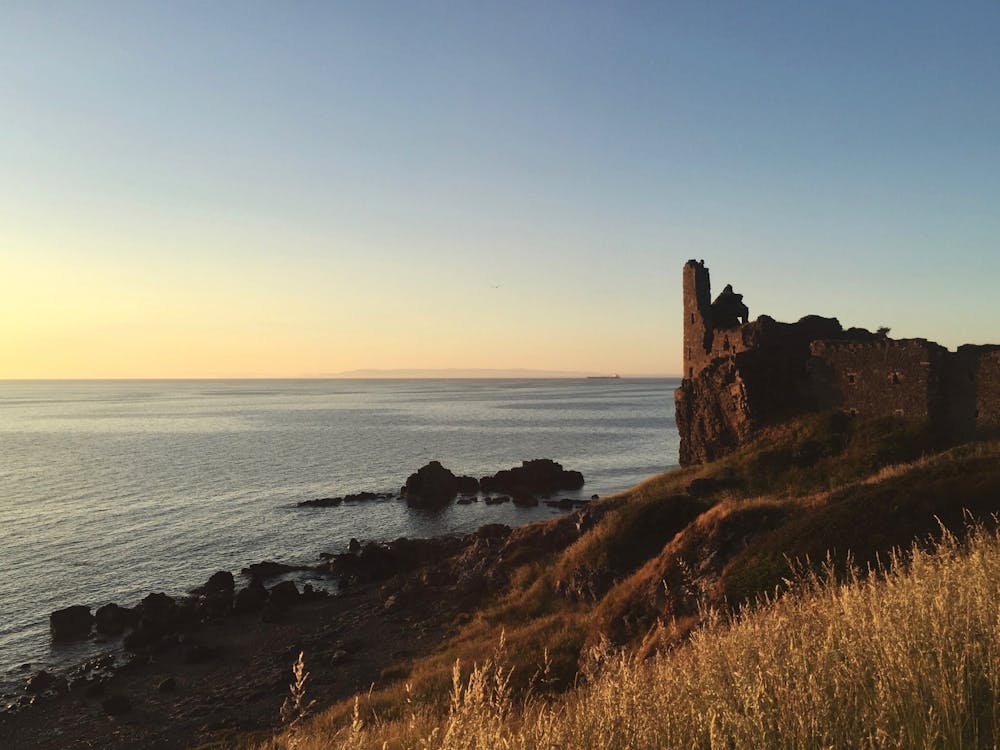
Between Ayr and Culzean, the small village of Dunure is one of the most photogenic spots on the Ayrshire coast. A cluster of whitewashed fishermen’s cottages surrounds a tiny working harbour, and above the village stand the atmospheric ruins of Dunure Castle — a 13th-century stronghold of the Kennedy family that clings to a rocky promontory above the sea. The castle has a dark history: it was here that the Earl of Cassillis roasted the Commendator of Crossraguel Abbey over a fire in 1570 in an attempt to force him to sign over the abbey’s lands — an episode that earned the place a grim reputation in Ayrshire folklore.
Today the village is altogether more welcoming. The views from the castle ruins south along the coast to Culzean and across to Arran are outstanding, and the ruins themselves are freely accessible. The village has a small café and a popular fish and chip shop. At high tide, waves break dramatically against the castle walls, making Dunure a particularly rewarding stop for photographers. It is easily combined with Culzean on a self-drive day trip — follow the A719 south from Ayr and Dunure appears after about seven miles.

Ayr Town Centre
Ayr is the largest town on the Ayrshire coast and a natural hub for a day trip from Glasgow. The town centre has a good range of cafés, restaurants and independent shops alongside the major retail chains, and the beach — a long sweep of golden sand stretching south from the harbour — is one of the finest in the west of Scotland. The town also has several Burns-related sites worth visiting alongside the main attractions south of the town.
Auld Brig and the Town Centre
The Auld Brig (Old Bridge) over the River Ayr dates from the 13th century and is mentioned by Burns in his poem The Brigs of Ayr. It is still open to pedestrians and offers a fine view of the river and the surrounding townscape. Nearby, a large bronze statue of Burns stands in the town centre, and the Burns House Museum on Burns Statue Square preserves items connected to the poet’s time in Ayr. The town’s High Street has all the major chain stores alongside independent retailers and a covered shopping centre.
Ayr Beach
Ayr beach stretches for nearly two miles south of the town centre, backed by a promenade with beach huts, an amusement park and the Low Green park area. On a warm summer day it attracts families from across the west of Scotland and can become quite busy, but its scale means it never feels overcrowded. The beach is ideal for a post-lunch walk before driving south to Dunure and Culzean or heading back to Glasgow.
Ailsa Craig and Turnberry
Continuing south from Culzean along the A77 brings you to the Turnberry area, where the famous Turnberry golf resort sits behind a lighthouse on a rocky promontory. From the lighthouse, the view across the water to Ailsa Craig is extraordinary. Ailsa Craig — nicknamed “Paddy’s Milestone” because it sits roughly halfway between Glasgow and Belfast — is a volcanic plug island rising 338 metres from the sea. It is home to one of the largest gannet colonies in the world, with around 40,000 breeding pairs nesting on its dramatic cliffs each summer. The distinctive blue hone granite quarried from the island’s surface has been used to produce curling stones for the sport’s governing bodies for generations, making Ailsa Craig curling stones the gold standard worldwide. Boat trips to Ailsa Craig depart from Girvan harbour during summer months.
The view of Ailsa Craig from the Ayrshire coast — with Arran’s peaks visible to the north and the lighthouse at Turnberry in the foreground — is one of the defining images of this coastline and justifies the drive south even if you do not venture onto the island itself. Turnberry has a small village and the famous golf course, which has hosted The Open Championship multiple times and is regarded as one of the finest links courses in the world.
Suggested Day Itinerary
A well-structured Ayrshire day trip from Glasgow can comfortably cover the main highlights in a single day, whether you are travelling by car or public transport.
Morning: Robert Burns Birthplace Museum
Depart Glasgow by 9am — either by car on the M77 or by catching the early train from Glasgow Central to Ayr. Arrive at the Burns Birthplace Museum in Alloway by around 10am and allow two to three hours to explore the cottage, museum and Brig o’ Doon gardens thoroughly. There is a café on site for a mid-morning coffee, and the museum shop stocks a fine range of Burns-related books and gifts.
Midday: Lunch in Ayr
Head into Ayr town centre for lunch — the town has a wide range of options from casual cafés to sit-down restaurants specialising in fresh seafood. After lunch, take a short walk along the Auld Brig and down to Ayr beach if the weather is good, before driving south along the A719 coastal road.
Afternoon: Dunure and Culzean
Drive the A719 coastal road southward, stopping at Dunure village for photographs of the castle and harbour — allow 30 minutes here. Continue to Culzean, arriving around 2:30pm. Spend two to three hours exploring the castle interior and country park. If time allows, walk the clifftop path south of the castle for the best coastal views over the Firth of Clyde. Leave Culzean by 5pm to be back in Glasgow comfortably by 6:30pm.

Seasonal Advice and What to Pack
The best time for an Ayrshire day trip from Glasgow is between May and September. The longer days mean you have more time to explore, the coastal paths are at their finest in summer wildflower season, and the weather — while never guaranteed in Scotland — is more reliably dry and bright during these months. July and August are particularly busy, especially at Culzean and the Burns Museum, so arriving early and booking timed entries in advance is strongly advisable.
Spring visits in April and May offer quieter conditions, fresh greenery and excellent birdwatching on the coast, including the chance to see gannets fishing in the Firth of Clyde. Autumn — September and October — brings dramatic skies and golden light that photographers love, and the coastal paths are often quiet after the summer crowds have departed. Winter is the least recommended time for the coastal paths and Culzean’s outdoor areas, though the Burns Museum is open year-round and the castle interior can be visited in any season.
Whatever the season, pack layers and a waterproof jacket. The Ayrshire coast is exposed and wind can make it feel considerably colder than the temperature suggests. Comfortable walking shoes with some grip are essential for the clifftop paths at Culzean and the rocky approach to Dunure Castle. Bring binoculars if you have them — the coastal views, including Ailsa Craig and Arran, are best appreciated with a little magnification, and the birdlife along the coast is excellent throughout the year.
Practical Tips for Your Ayrshire Day Trip
- NTS membership pays off: If you plan to visit more than one or two NTS properties during your time in Scotland, annual membership quickly pays for itself. Both the Burns Birthplace Museum and Culzean Castle are NTS properties, and free parking at Culzean alone saves several pounds on each visit.
- Book Culzean in advance: Culzean Castle timed entry slots fill up quickly in summer, particularly at weekends. Book online at nts.org.uk before you travel to avoid disappointment on the day.
- Extend to an overnight stay: Ayr has a good range of hotels and B&Bs at various price points, and staying overnight allows you to see Culzean in the beautiful evening light and explore Turnberry, Girvan and Ailsa Craig the following morning. The Enterkine Country House Hotel, between Ayr and Kilmarnock, is a popular choice for a special occasion.
- Commonwealth Games 2026: If you are visiting Glasgow in late July or early August 2026 when the Commonwealth Games are taking place (July 23 to August 2), accommodation across the west of Scotland will be in very high demand. Book any overnight stays in Ayrshire well in advance if your trip coincides with the Games.
- Electric vehicle charging: Culzean Country Park has EV charging points in the main car park, and Ayr town centre has multiple public charging points — useful if you are driving an electric vehicle on the round trip from Glasgow.
- Railcard savings: If you hold a 16-25, 26-30, Family or Senior Railcard, you can save a third on ScotRail train fares from Glasgow to Ayr. The round trip without a railcard is around £16 per adult.
Where to Eat on the Ayrshire Coast
Ayrshire has a strong food scene built around excellent local produce — the county is famous for its dairy farming, with Ayrshire milk and cream prized across Scotland for their richness. Seafood landed at Troon and Girvan is particularly good, and several restaurants along the coast specialise in the freshest local catches.
- The Brig o’ Doon House Hotel, Alloway: Elegant dining in a historic setting right beside the Burns monument and river. Well suited to a special lunch or afternoon tea after visiting the Burns Museum.
- Cecchini’s, Ayr: Long-established Italian restaurant popular with locals and visitors alike. Well-priced and reliably good, with a broad menu and a warm atmosphere.
- Dunure harbour: Fresh fish and chips eaten on the harbour wall with views of the castle — a quintessential Ayrshire experience that costs very little and delivers a great deal.
- Happy Welly Cafe, Culzean Country Park: The Home Farm courtyard café is convenient for hot lunches, homemade soups and snacks during your country park visit. Outdoor seating is available in good weather.
- Wildings Hotel and Restaurant, Maidens: Acclaimed seafood restaurant near Turnberry, worth booking ahead for dinner if you are staying overnight in the area. The lobster and crab dishes are particularly highly regarded.
Beyond Burns: More Ayrshire Highlights
While the Burns trail and Culzean Castle are the headline attractions, Ayrshire offers plenty more for visitors who wish to explore further or make a return visit to the area.
Dean Castle and Country Park, Kilmarnock is a fine medieval castle and grounds just off the M77, making it an easy first stop on the drive south from Glasgow. The castle houses impressive collections of arms, armour and musical instruments and is set within a 200-acre country park with deer, highland cattle and woodland walks — entry to the park is free, making it excellent value for families.
Crossraguel Abbey, near Maybole south of Ayr, is one of the best-preserved medieval abbeys in Scotland, founded in 1244. The extensive ruins include the gatehouse, dovecot, abbot’s house and chapter house, and the site is managed by Historic Environment Scotland with modest entry charges. The abbey is less visited than the headline attractions and often refreshingly quiet.
Troon is a popular seaside town with excellent beaches, a fine links golf course (Royal Troon hosts The Open Championship regularly) and a ferry terminal for crossings to Larne in Northern Ireland — potentially useful if Ayrshire is a stopping point on a longer journey. The beach at Barassie, just north of Troon, is less visited and often quieter than Ayr beach.
Irvine is home to the Scottish Maritime Museum, which traces the history of Scotland’s seafaring and shipbuilding heritage on the banks of the River Irvine. The museum’s collection includes historic vessels, engines and maritime artefacts. Irvine was also Burns’s home for a period in 1781 when he worked as a flax dresser, and the town has its own Burns Club — one of the oldest in the world.
Final Thoughts
An Ayrshire day trip from Glasgow delivers an exceptional combination of literary heritage, spectacular castle architecture, dramatic coastal scenery and genuinely good food — all within easy reach of the city. Whether you spend the day following in the footsteps of Robert Burns, exploring the cliff walks and formal gardens of Culzean, or simply driving the scenic coastal road and stopping wherever catches your eye, Ayrshire consistently rewards visitors with some of the finest scenery in the west of Scotland.
The route is flexible enough to suit families, couples, solo travellers and group tours alike. With reliable train connections from Glasgow Central to Ayr and a straightforward drive on the M77, there is no barrier to making this one of the highlights of any Glasgow visit. Pack the waterproofs, charge the camera and head south — Burns Country awaits.
Ayrshire is one of the trips covered in our guide to day trips from Glasgow, and it pairs well with almost any of them. Head north from the city instead and Loch Lomond and the Trossachs is under an hour away by train to Balloch; carry on up the A82 and you reach Glencoe and the Highlands, the most dramatic driving day within range of Glasgow. For history rather than coastline, Stirling Castle is 30 minutes from Queen Street, and a day in Edinburgh takes 50 minutes on the express — a city day to set against Ayrshire’s beaches.