The Glasgow Science Centre is the city’s biggest single family attraction — three floors of hands-on exhibits, a digital planetarium, an IMAX cinema and a flight-simulator academy, all wrapped inside a curving titanium-clad building on the south bank of the Clyde.
If you’re travelling with kids and wondering whether it’s worth the £17 adult ticket, the short answer is yes — particularly for ages 3–14. This is an honest 2026 guide to the Glasgow Science Centre with kids: what to expect at each age, how to plan your day, what’s good (and what’s not), and how to save on tickets.
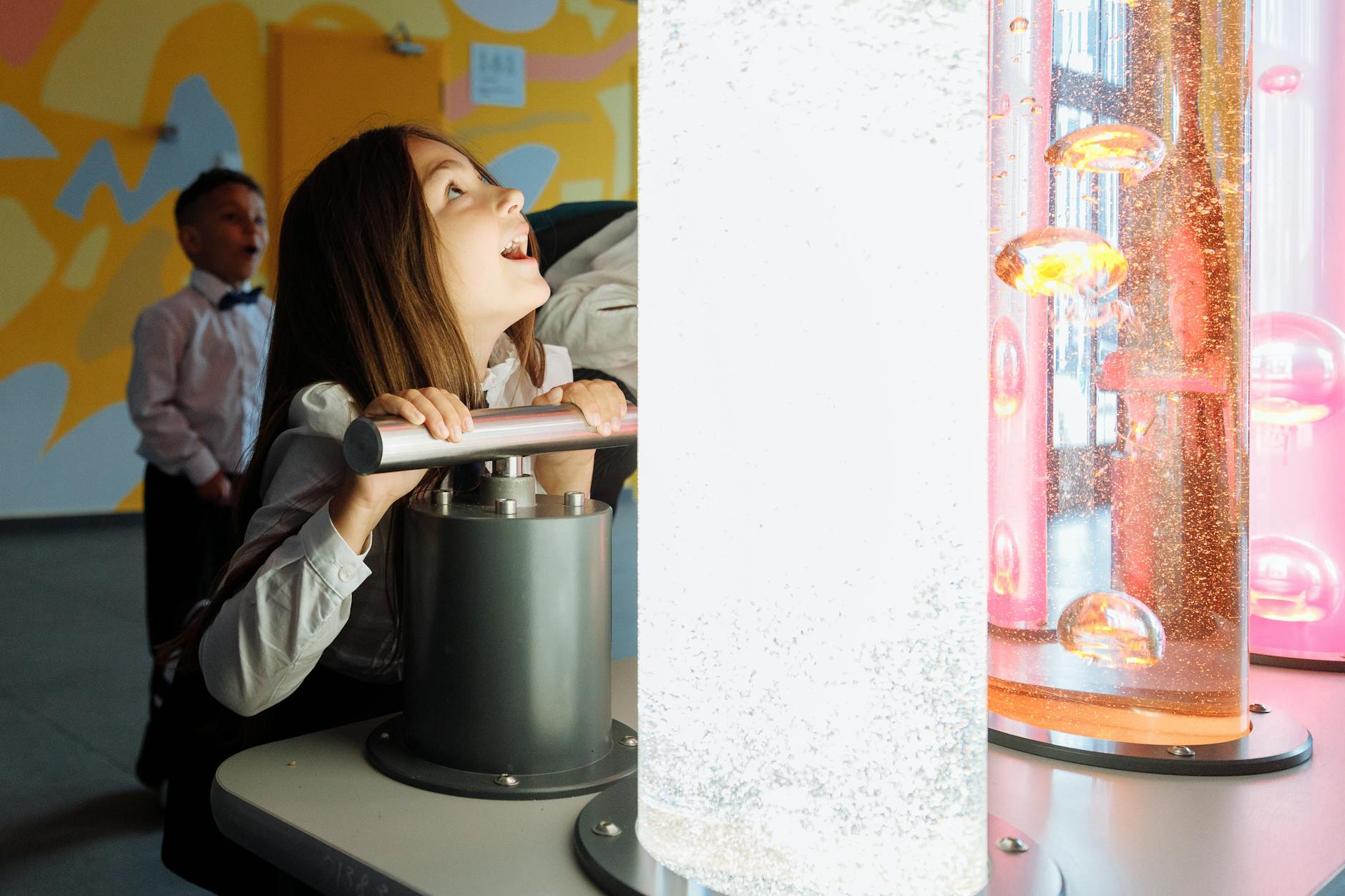
Glasgow Science Centre at a glance
Address: 50 Pacific Quay, Glasgow G51 1EA. Opening hours (2026): Wednesday–Sunday 10am–5pm in term time; daily during school holidays. Closed Mondays and Tuesdays in term. Adult ticket: £15.50 off-peak, £17.05 peak. Child (3–15): £12.00 off-peak, £13.20 peak. Under-3s: free. Add-ons: Planetarium £3.50; IMAX 3D £3.50. Plan for: 3–4 hours minimum.
It helps to know that the Glasgow Science Centre is really several attractions on one Clydeside site at Pacific Quay. The centrepiece is the Science Mall, three floors of more than 250 hands-on, interactive exhibits where nothing is behind glass and everything is built to be poked, pulled and played with. Alongside it sit a Planetarium, an IMAX cinema, and the Glasgow Tower — at 127 metres the tallest freestanding structure in Scotland and the only tower in the world designed to rotate a full 360 degrees from the ground.
Realistically you want three to four hours here, and a young family can happily fill a whole day, especially if the weather has turned. It is one of the best wet-weather options in the city.
A couple of planning points the listing doesn’t spell out. The opening days change with the school calendar — it runs Wednesday to Sunday in term time and daily through the holidays — so the single most useful thing you can do before setting off is check the official site for the exact day you’re going, because a wasted journey to a closed centre is a miserable start. Booking online ahead of time is also worth it: it’s usually a little cheaper than the gate and, on busy weekends and holidays, it guarantees you get in when walk-up tickets can sell out. Build in three to four hours minimum; a young family on a wet day can fill the lot.
Who is the Glasgow Science Centre best for?
Genuinely 3 to 14 years old. Younger children (under 3) can enjoy the soft play area and a few accessible exhibits but won’t get full value. Tweens and teens (10–14) will love the BodyWorks gallery and the flight simulators. Older teens often enjoy a 90-minute visit but will probably finish faster than younger siblings. Adults — even childless ones — generally have a great time too.
To put the age guidance another way: think of the centre as scaling with how much a child wants to do things with their hands. The three-to-eight band gets the most for the money, because almost every exhibit is built to be pulled, pushed and played with, and that’s exactly how younger children explore. Nine to fourteen is the sweet spot for the trickier interactives, the body gallery and the flight simulators, where there’s enough challenge to hold them. Above that, older teens and adults tend to enjoy a sharper, shorter visit — an hour and a half of the best exhibits plus an IMAX feature — rather than a full day. Plan the length of your visit around the youngest in the group, not the oldest.
Top exhibits to see
1. The Science Mall (the main building)
Three floors with 300+ exhibits, themed across topics like BodyWorks (giant tongue, nerve-test reaction games, virtual surgery, organ jigsaw puzzles), Powering the Future (renewable energy interactives, build-your-own wind turbine, pedal-power racing), and the Climate Action Hub (an updated 2024–25 zone tackling sustainability through hands-on science).
Highlights for younger children: the giant bubble wall, the Bernoulli ball-floating column, the optical illusion room. For older kids: the brain-wave headsets, the vortex cannon, the build-and-test marble runs.
2. The Planetarium
Scotland’s only fully digital planetarium. The 360-degree dome shows live presenter-led astronomy talks (about 25 minutes) and pre-recorded “fulldome” films. Live shows are the highlight — a real astronomer takes you on a tour from Glasgow into the Milky Way. £3.50 add-on per person; book on the day at the welcome desk. Best for ages 5+; kids under 4 can find the dark too long.
3. The IMAX
The biggest cinema screen in Scotland. The IMAX shows nature and space documentaries (Penguins: A Love Story, Deep Sky) and occasionally first-run blockbusters in 3D. £3.50 add-on. Films run 45 minutes (documentaries) or 2 hours (features). Best paired with the rest of your visit.
4. Newton Flight Academy
Real, full-motion flight simulators where children sit in the pilot’s seat. £15 for a 30-minute lesson with an instructor (book ahead — slots sell out). Best for ages 8+; younger kids can fly a non-motion simulator on the ground floor for free.

5. The Glasgow Tower
The 127-metre tower next to the Science Centre is the only building in the world that can rotate 360 degrees. It’s been closed for refurbishment in recent years; check the official site for opening status. When open, the tower offers Glasgow’s best skyline view.
Steer the kids towards the things that land best by age:
- BodyWorks — a whole gallery about the human body, with a climbing wall, reaction-test games and gross-but-brilliant interactives.
- The daily live science shows and demonstrations — explosions, liquid nitrogen and static-hair theatrics that even teenagers enjoy.
- The Planetarium — a calm, awe-struck half hour under the stars; book a show time when you arrive.
- A dedicated area for under-5s, so the littlest visitors have somewhere to roam safely.
- Optical illusions and perception puzzles that quietly teach without anyone noticing.
A simple route stops the day descending into chaos. Start at the top of the Science Mall and work down floor by floor, so you cover everything once rather than charging up and down stairs chasing the loudest exhibit. Catch one of the daily live science shows if the timings line up — the liquid-nitrogen and static-hair demonstrations are the bit even teenagers talk about afterwards — and book any Planetarium show or Flight Academy slot when you arrive, because the popular times go first. If the weather’s foul and you want a guaranteed indoor hit, the bubble wall and the Bernoulli ball column on the lower floors keep the youngest visitors busy for a surprisingly long time.
Planning your visit by age
Under 5s
Allow 2–3 hours. Focus on the ground-floor soft play area, the bubble wall, the Bernoulli ball column, the under-5 zones in BodyWorks. Skip the Planetarium and the longer IMAX features.
Ages 5–8
Allow 3–4 hours. The full Science Mall plus a 25-minute live planetarium show is the right size of day. Add the IMAX if you have stamina; skip the flight simulators.
Ages 9–14
Allow 4 hours. Add the Newton Flight Academy lesson. This is the sweet-spot age range for the centre — almost every exhibit will engage them.
Teens 14+
The full Science Centre is genuinely interesting at any age but a teen’s “wow” factor lasts about 90 minutes. Pair with the IMAX (a strong feature film), or use the visit as a half-day before crossing the river to the Riverside Museum and the Clydeside Distillery for older interests.
Whatever the age, pace beats completeness here. The commonest mistake is treating the place as a list to finish; children get far more out of doing ten exhibits properly — building the marble run, racing the pedal-power bikes, actually watching what happens — than rushing fifty. Let them double back to the two or three things they loved, because the repeat is where the learning sticks. If energy crashes mid-afternoon, that’s the moment for a sit-down Planetarium show or an IMAX film: a calm, dark half-hour off their feet resets everyone for a final lap of the floors.
Tickets and how to save
Family tickets (2 adults + 2 children) save around 10% on individual tickets. Off-peak (Wed–Fri term-time) tickets are £1.50 cheaper than peak (weekends, school holidays). The Glasgow Science Centre annual membership at £80 family / £45 adult includes unlimited entry, free planetarium and IMAX, and discounts at sister attractions — pays back after two visits, worth it for locals or longer stays. Booking online is mandatory at peak times.
Buy online in advance — it is usually cheaper than the gate and guarantees entry on busy weekends and school holidays. The Science Mall is the core ticket; the Planetarium, IMAX and Glasgow Tower are add-ons, so decide which extras you want before you book. If you live locally or are staying a while, an annual pass can pay for itself in two visits, and the youngest children typically go free.
A few more ways to keep the cost down. Off-peak tickets — weekday term-time — are a little cheaper than peak weekends and holidays, so if your dates are flexible, a midweek visit saves money and dodges the crowds in one move. The family ticket shaves roughly a tenth off buying individually, the under-threes go free, and the annual membership pays for itself in about two visits, which makes it a genuine saving for locals or anyone on a longer stay rather than a gimmick. Decide which add-ons you actually want — Planetarium, IMAX, Flight Academy — before you book, since adding them at the desk on the day costs the same but risks the slot you wanted being gone.
If you’re watching the wider budget, chain the centre with the free attractions across the river to bring the average cost of the day right down; our Glasgow on a budget guide has more on stretching a family trip.
Food and drink
The Science Centre Café on the ground floor sells sandwiches, hot kids’ meals (£6 lunch boxes), proper coffee and the occasional pizza/pasta dish. Picnic-friendly: there’s a designated indoor lunch area where you can bring your own packed lunch — a generous policy. Outside, the riverside walkway has plenty of picnic benches.
The honest steer on food: the cafe is fine and convenient, but it adds up fast for a family, so the indoor picnic area is the budget move — bring your own lunch, refill the water bottles at the stations on each floor, and you’ve cut a real chunk off the day’s cost. On a dry day the riverside benches outside are a pleasant alternative, and being able to step out for ten minutes resets younger children before another lap of the floors. If you do buy in, the kids’ lunch boxes are the sensible order; the queues build in the standard noon-to-one window, so eating slightly early or late saves a wait. There is little else to eat at Pacific Quay itself, so for a proper meal cross Bell’s Bridge towards Finnieston and the West End, where our pick of Glasgow restaurants that welcome children covers the rooms with space for a buggy.
How to get to the Glasgow Science Centre
Subway: Cessnock or Ibrox — both 15 minutes’ walk via the Bell’s Bridge across the Clyde.
Train: Exhibition Centre is the closest train station, 10 minutes’ walk via Bell’s Bridge.
Bus: First Bus 23, 26 from city centre — stops outside the SEC.
Driving: Pay-and-display car park on site (£8 for 4+ hours).
Walking from city centre: 25 minutes via the Clyde Walkway and Bell’s Bridge — pleasant on a dry day.
The Centre is at Pacific Quay on the south bank of the Clyde. The simplest public-transport route is the Subway to Cessnock, then about a 10-minute walk across the river, or a city bus toward Pacific Quay or the BBC. There is on-site parking if you drive.
It sits almost directly across the water from the Riverside Museum and the Tall Ship, so on a dry day you can pair the two via the footbridge or a short bus hop for a full day on the river. For routes and tickets, see our getting around Glasgow guide.
To make the public-transport route simple: take the Subway to Cessnock or Ibrox and it’s about a fifteen-minute walk across the Clyde via Bell’s Bridge, or hop a city bus towards Pacific Quay and the BBC. The walk over the river from the centre is genuinely pleasant on a dry day and only takes around twenty-five minutes along the Clyde Walkway. If you drive, the on-site car park is the easy option but check the charge and have the Subway as a backup on a packed holiday Saturday, when the car park fills. For every route and the fares, see our getting around Glasgow guide.
Combine with other family attractions
Pacific Quay sits on the south bank of the Clyde, directly opposite the Riverside Museum and the Tall Ship Glenlee. A double-museum day is one of the best free/cheap family options in Glasgow:
- Glasgow Science Centre (4 hours; £17 adult, £12 child)
- Walk over the Bell’s Bridge (5 minutes)
- Riverside Museum and Tall Ship (2 hours; both free)
Total day cost: under £40 for a family of four. See our Riverside Museum guide for the second half.
The reason the double-museum day works so well is geography: the Science Centre sits almost directly across the Clyde from the free Riverside Museum and the Tall Ship, linked by Bell’s Bridge in about five minutes on foot, so you need no transport between them. The natural order is the paid, hands-on Science Centre when energy is high and younger children most need to burn it off indoors, then the free museum and ship across the water afterwards — a full day out for a family of four for well under what most cities charge for a single attraction. If the forecast turns and you want a backup plan entirely under cover, our rainy-day activities for kids guide has more options nearby. If you need a second day out, Loch Lomond and the Falkirk Kelpies are each about 30 minutes from the city and head up our list of best family day trips from Glasgow.
Accessibility
The Glasgow Science Centre is fully accessible. Step-free throughout, accessible toilets on every floor, free wheelchair loan, large-print labels, sensory-friendly Sundays once a month, and trained staff who’ll make adaptations on request. The IMAX has an audio-description programme and the Planetarium has live captioning options.
A bit more detail for families who need it. The whole centre is step-free with lifts between the three floors, so a buggy or wheelchair gets everywhere the exhibits are, and there are accessible toilets on every floor rather than tucked away on one. The monthly sensory-friendly Sunday mornings — lower sound, dimmed lights, smaller crowds — are worth planning around if anyone in your group finds a busy, noisy room overwhelming, and the staff are used to making small adaptations if you ask at the desk. Free wheelchair loan and large-print labels are available, and the cinema and Planetarium each have access options, so check those when you book the add-ons.
What to bring
A water bottle (filling stations on every floor), a light jacket (the IMAX runs cold), buggy storage if needed (free near the entrance), a packed lunch if you want to save on food costs.
A short kit list saves money and meltdowns. Pack a refillable water bottle for each child — the filling stations on every floor make this an easy win — and a light layer, because the IMAX and the darkened Planetarium both run cool even when the galleries are warm. Bring your own lunch if you’re keeping costs down, a small bag for coats and the family-trail bits, and a phone or camera for the photo spots. Buggy storage near the entrance is free, so you can park a pram and travel light around the floors rather than wrestling it through the busier exhibits.
Common visitor mistakes
- Trying to do it all in 2 hours — the full centre takes a half-day. Allow more time than you think.
- Skipping the Planetarium because it’s an add-on — for £3.50 it’s the highlight for kids 5+.
- Going at peak weekends without booking — on Saturdays in school holidays, walk-up tickets are often sold out by midday.
- Forgetting a packed lunch — the café is good but pricey for a family.
One mistake worth flagging beyond the obvious is misjudging the closed days. Because the centre shuts on Mondays and Tuesdays in term time, families on a city break occasionally turn up to locked doors at the start of the week — always confirm the opening day for your exact date first. The other quiet trap is arriving without a plan on a packed holiday Saturday and burning the first hour deciding what to do; glance at the show and demonstration times on arrival, book the Planetarium slot you want, and start at the top of the building. A little structure turns a chaotic, expensive day into a smooth one.
FAQs
How much does the Glasgow Science Centre cost?
£15.50 adult / £12.00 child off-peak; £17.05 / £13.20 peak. Under-3s free. Planetarium and IMAX are £3.50 add-ons each.
How long do you need at Glasgow Science Centre?
3–4 hours for a typical family visit; allow 5 hours if you’re adding the Planetarium, IMAX and Flight Academy.
Is Glasgow Science Centre good for toddlers?
Yes — the dedicated under-5s zone, soft play and the bubble wall are all under-3 friendly. Allow 2 hours; under-3s are free.
Is Glasgow Science Centre indoors?
Almost entirely indoors, making it a strong wet-weather day option in Glasgow.
Can you bring food into Glasgow Science Centre?
Yes — a designated indoor picnic area on the ground floor is open all day. Reusable water bottles can be refilled at filling stations on every floor.
Is the Glasgow Science Centre worth it?
For families with children aged 3–14, yes. It’s one of the best science centres in the UK and a strong half-day option even in poor weather.
Plan more family days in Glasgow
This article is part of our complete Glasgow with kids family guide. For more ideas, see our deep-dive on best Glasgow playgrounds for kids, the free Glasgow museums and galleries and our companion free things to do in Glasgow list.